Category Archives: Current Events

Talking With Kids After Scary Events

Young children may not understand the news of the tragedy in Boston, but they can sometimes pick up on the fear and sadness of those around them. They may hear others talking and be concerned but are not able to ask us what is happening. We all want to protect our little ones and keep them from knowing about these events but we need to watch our children and be aware of their needs. Children may ask questions and it helps if we can talk with them.
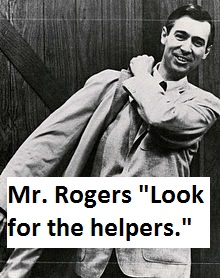
Mr.-Rogers
Children can imagine some very frightening situations so talking about a situation can be important. Kids do not need to know all the details; you may want to say something simple like: 2 bombs exploded and some people were very badly hurt, but kids do require reassurance. We cannot tell children that something like that will never happen to them; we can remind them that we love them and will do our best to take care of them. Instead of keeping scared, sad feelings bottled up inside, it’s much better to talk about them.

Mr. Rogers shared some wise words from his mother, “When I was a boy and I would see scary things in the news, my mother would say to me, “Look for the helpers. You will always find people who are helping.” And lots of people did come to help. Police came, firefighters, doctors and nurses, and even some people came from their houses to help, because others needed a place to stay. Children have big hearts and may want to help too. We can acknowledge this in different ways. Is there a family in the neighborhood that could use some cookies? Could they help someone close by walk their dog? There may be something else that your family can do in your own area and this will also help children deal with the situation and their feelings as we all pray and hope together.

Share this:
Share this page via Email Share this page via Stumble Upon Share this page via Digg this Share this page via Facebook Share this page via Twitter
Share

Kindergarten Readiness Wears a Pink Shirt Today

Why is kindergarten readiness wearing a pink shirt today? Because it’s Pink Shirt or Anti-Bullying  Day. This year, it is just 6 years old and it started when 2 boys got a group of friends to all wear pink shirts in support of a classmate who was teased and bullied about wearing a pink shirt. Since then, the idea has spread and has become a day to talk about how bullying can affect kids and what we can do.

It’s an important day for parents, too. In 2012 Dr. Rashmi Shetgiri led a research study into bullying. Results were published in the American Journal of Public Health, “We discovered how important parental communication and involvement with their children can be in preventing bullying,” Shetgiri said.

importance of parent involvementChildren’s learning in school only builds on what parents have already started at home. In Dr. Shetgiri’s words, “I can never state enough the importance of being as present and involved in a child’s life as possible.”

For a play-of-the-day today, spend some time with your child. You can talk together, read a book, sing some songs, build with blocks, play with toys, go for a walk, or swing in the park. Having children help with a task or chore gives them a chance to feel like they are contributing. Oh, and wear a pink shirt. After all, it’s Pink Shirt Day. Is this an issue for your child?

Pink-shirt-day2 - CopyP.S. Just had to add a postscript when I saw this on FB. It’s perfect for today and big advice from a little people.

“Someone was excited to wear his pink shirt today and said “mommy I need to wear pink to my school today so people will stop being mean to each other and saying mean things, you know mommy that’s not nice” pretty cool to see that he understands the concept behind this. ❤”

Share this:
Share this page via Email Share this page via Stumble Upon Share this page via Digg this Share this page via Facebook Share this page via Twitter
Share

Kindergarten Readiness Gets Inspiration from SuperBowl Ads

Inspiration for a post on kindergarten readiness fun and learning came from the Super Bowl ad where a little boy in the back seat asks where baby comes from. His dad tells a great story about a planet called Babylandia and the whole journey to get to Earth. Of course, the little one in the back seat isn’t buying it so the dad turns on the song Wheels on the Bus and the family sings along.

healthy sexual development for preschoolersExplaining to kids about where babies come from is not just a part of kindergarten readiness, it’s also very important for their own safety and protection. On a Learn and Play with Mrs. A radio show, I was able to talk to Kerri Isham, who is a teacher with special training in children’s healthy sexual development. She explained the words safe-touch, unsafe touch, and secret touch. Safe-touches are the ones that feel good, like hugs, tickles, and snuggles or sometimes not so good, like getting dirt out of a scrape or having the doctor check out a sore tummy. Kids seem to know quite early that unsafe touches, such as kicking, hitting, biting, and scratching, are not just unsafe but hurtful, too. Secret touch is private and for adults only. Discussing where babies come from and different kinds of touching helps children understand and build boundaries and gives them the words they might need to use to tell us about any problems.

Kids also need to know the correct words for all body parts, including the private ones. By treating all body parts as special we are not drawing extra attention to the private ones. We can also let kids know that since some parts are private, we’ll talk about them in private spaces, like home, not middle of the grocery store. That doesn’t always work, tho, as many of us know!

developing kindergarten readinessTalking about this with your kids before they come to school and hear it from anyone else will establish you as the go-to source for information and concerns. Unfortunately, the dad in the car in this Super Bowl ad is now competing with “But Jake said”. Does this give you some better ideas than The Wheels On The Bus?

Share this:
Share this page via Email Share this page via Stumble Upon Share this page via Digg this Share this page via Facebook Share this page via Twitter
Share

The Importance of Education and Universal Children’s Day

Nov. 20th, Universal Children’s Day, will be celebrated in many countries of the world. This day commemorates the adoption of the United Nations Declaration Of The Rights Of The Child and UN Convention On The Rights Of The Child. For 2012, the critical importance of education for children is being recognized with a new initiative called Education First aiming to “put every child in school, improve the quality of learning, and foster global citizenship.

Education does not just mean school. When it comes to learning and development, the early childhood years are key. Parents, caregivers and communities are the teachers for those years before children ever get to school. To support your child’s learning and fun, check to see if there are any events in your community. You may be able to bring children to work for the day or go for a special lunch treat. Is there a community children’s charity that could use some support? Even young children are interested in helping others. You and your child may want to take some books, toys or clothes to a center for children in need

More and more, as a global community, we are recognizing our responsibility to support children and education. What can you do for Children’s Day?

Share this:
Share this page via Email Share this page via Stumble Upon Share this page via Digg this Share this page via Facebook Share this page via Twitter
Share

Some Handy Ideas for Kindergarten Readiness: Hand Game

For preschool children the events of 9/11, 2001 were more then two of their lifetimes ago but I try and do a kindergarten readiness post on this day that has some recognition of the significance of the date.  This picture shows a fun game that needs careful attention and thinking. At the same time it reminds all of us of the importance of hands. Most of the time, 2 people play but the more people, the more the fun.

hand-gameTo play, first you put one hand flat on a table, then your child puts one hand on top of yours. Next, your hand, and your child puts a hand on the very top. Now, carefully slide your bottom hand out and put it on top. Then, your child slides out his/her bottom hand and put it on the top. Once your child has the idea, try going faster and faster. Usually, the hands get all out of sequence and the game turns into giggles.

This “your hand, my hand” switching is a very early game to teach taking turns. It’s a fun way to practice focus and concentration. Children love to play, for short bits of time.

For even more fun, try it with 3 or 4 people. Then it gets really complicated. Brains can’t keep up with hands. As you play, you may want to think of all the hands that helped on this day. How are hands meaningful for you?

Share this:
Share this page via Email Share this page via Stumble Upon Share this page via Digg this Share this page via Facebook Share this page via Twitter
Share

Helping Kids Get Ready For Kindergarten: One Small Step

The walk through the kindergarten or preschool door may only be a small step for your child’s feet, but it is a giant leap in terms of independence and expansion of your child’s world. Just as Neil Armstrong had to be prepared for his journey, so do kids need us to help them with kindergarten readiness. The story of Neil Armstrong and his visit to the moon has inspired older generations. Going off to kindergarten is an adventure for kids; their “outer space” is the world beyond home.

There are some wonderful stories that you can read to your child about going to school. Bookstores and grocery stores will have displays of books and libraries will have some that you can check out. There are dozens and dozens of titles. Look for a book that will encourage you and your child to talk about all different kinds of feelings: excited about going, maybe a little nervous or scared. As you read to your child, you may notice some body reaction. Does your child seem to be relaxed, eager to check out the pictures and ask lots of questions or stiffen up and look down and away? These are clues about how your child is feeling and are especially important as kids might not have the words they need or be able to identify their feelings.

123-stopMake up your own stories, too, and suggest some feelings. Your child may tell you that’s not right or be relieved that you know. Here’s an example: One day, a little boy or girl who looked just like you…hmm, maybe it is you…was thinking about going to school. This little person said: I’m going to school. I’m going to school by myself. I’m going to school by myself and I am excited. Yes, I am. Yes, I…..Yes…..Well, maybe I am a little, sort of, kind of, well…..I think I am feeling scared.

Remember, in a story you can imagine anything and find some solutions that will work for the people in the story that will work for your family. I love the true story of a little girl who was taking extra long one morning to get ready. Her mother told her to hurry or she’d be late for the bus and miss school. The little girl replied “I’d rather stay home and miss school, that go to school and miss home.” No matter how excited children are to say hello to school, they still have to say goodbye to home. It might not be the moon, but it can feel like a very long way.

Instead of ”3-2-1 -Blast off!” are you and your child ready for
1-2-3-Kindergarten?

Share this:
Share this page via Email Share this page via Stumble Upon Share this page via Digg this Share this page via Facebook Share this page via Twitter
Share

Kindergarten Readiness and Olympic Closing Ceremonies

The Closing Ceremonies of the London Olympics had some deeper meanings for all of us, far beyond kindergarten readiness. As the Games closed in London, the Olympic flag was handed to the next host city reminding us that when one thing ends, something else begins. London sadly says goodbye to the games, and Rio eagerly awaits it’s turn.

Kindergarten is like that. As kindergarten starts, every day the child closes the door at home and opens the one at school. For parents, there is sadness mixed with the joy and pride of watching children take their first steps into the world beyond home.

Perhaps, this circle of endings and beginnings is reflected in the Olympic rings. Children, just like adults, need to know that it is okay to feel sad when things end and they need to be reassured that there is something new beginning. The shape of a circle can help them understand how things can go round and round. Many of the athletes will soon start training for the next time and dreaming of a new competition and possibility.
Are there some endings/new beginnings for your child too?

Share this:
Share this page via Email Share this page via Stumble Upon Share this page via Digg this Share this page via Facebook Share this page via Twitter
Share

Kindergarten Readiness and Olympic Colors

In many homes, since the tv is on and families are watching the Olympics, parents can take advantage of the fun for some kindergarten readiness learning. Part of appeal is all the bright colors of the athletes, special decorations and each country’s flag. Learning colors is an important skill for young children. Before children can accurately name colors, they need to make some complex brain connections.

abc-colors

sorting colors

Every color has many variations; for example some of the blue uniforms worn by the athletes are pretty electric and some are quite deep and dark. The reds vary from almost orange to almost purple. Also, the same objects can have different colors. Even something as ordinary as the running shoes are as colorful as the rainbow. No wonder it’s so hard for kids to learn colors.

One of the Olympic ads reminds us that colors also have meanings. The colors in each country’s flag have special significance. For instance, in the South African flag the green represents the land, gold is the mineral wealth and black symbolizes the people.

While the meaning of colors is not of interest to kids, children often have very definite favorites. A perfectly good item may be rejected because it is the wrong color. If possible today, perhaps you and your child can have some fun with colors?

Share this:
Share this page via Email Share this page via Stumble Upon Share this page via Digg this Share this page via Facebook Share this page via Twitter
Share

Kindergarten Readiness And Olympic Goal-Setting

Have you heard all the Olympic athletes talk about setting goals for themselves? Some were successful in achieving them and some terribly disappointed. But they all had something to strive for. How about children? Do they set goals?
hopscotch
They surely do. We sometimes call it by less positive names as a baby in a high chair figures out how to balance a drippy bowl on his head, or a wee one manages to pull herself over to the goal of the dog dish. Testing how many books and big blocks to stack by the counter to reach the cooling cookies does not immediately seem like goal-setting. But kids have positive goals, too. Finishing a puzzle and jumping all the way to the end of a hop-scotch are examples of setting goals in a play activity.

Besides play, goal-setting is a thinking and learning strategy. As children set goals, they are developing important brain connections. Some goals are realistic, such as being able to get dressed all by “my very own self,” while others, like building a tower as high as the sky, are not. Children are deciding what they want to accomplish, figuring out the way to do it and then taking that action. 1, 2, 3! Children and adults use this same 3-step process to go from baby steps to a goal.

As parents and caregivers, we can celebrate their success and encourage our kids when needed. We do not always have to agree with the goal as in “Mommy, I’m going to fly off the counter,” or allow such things as jumping off the top bunk into a basket of clean clothes ready to be put away. We can also set goals for kids, such as they get to put all the red things in the toy box and we’ll put away all the green or they can slide down the slide all by themselves and we’ll catch them at the bottom. Supporting kids as they discover and explore setting goals will influence them far beyond kindergarten readiness. In what way will you and your child set some goals?

Share this:
Share this page via Email Share this page via Stumble Upon Share this page via Digg this Share this page via Facebook Share this page via Twitter
Share

Kindergarten Readiness Goes To Mars

Kindergarten readiness goes to Mars and other places in outer space and beyond. And how does it do that? With play and imagination!

playing_in_the_dirt

This isn't dirt. It's Mars...

Just like the Olympic athletes, the scientists and engineers that worked on the Mars rover landing this morning were one time little children. As little children they played with blocks and other objects, pretending they were going as far as their imaginations could take them.

This is an exceptional time to remember the value of play, with the excitement of the Olympics and the achievement of a Mars landing. As a parent of caregiver of our rising stars, is there a way that you can nurture and encourage your child’s play today? PLAY!

Share this:
Share this page via Email Share this page via Stumble Upon Share this page via Digg this Share this page via Facebook Share this page via Twitter
Share