Tag Archives: Easter activities

Kindergarten Readiness: Easter Egg Hunt

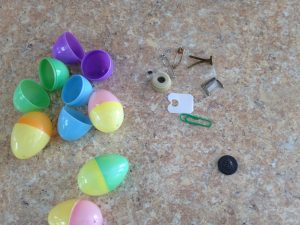
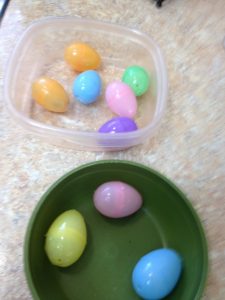
During an Easter egg hunt kids can find not just eggs, but fun, early learning and kindergarten readiness, too. Many places will have community activities this weekend and some families will do this at home. But wherever you are, as kids are hunting and finding eggs, they are practicing looking for details. They need to sort out what is relevant information and what is not. For instance, both some rocks and eggs are oval shapes, but the colors will be different. Kids will concentrate and bring their attention back from distractions.

developing kindergarten readinessAdults can extend the learning but adding in some comments, “Oh look, you find a blue egg.” This reinforces color skills and adds in some language. Placement can be tricky concepts. Is an egg in the grass or on the grass? Kids need to hear about in, on, beside, under, above and other words over and over to build their understanding.

Plus, in a way kids are connecting with others on the same hunt this weekend in various places around the world and participating in an activity that’s been done far into the past and will continue for future generations. All this adds up to early learning and fun that will last far beyond school. What else might families and kids find when they hunt for eggs this weekend?

Share this:
Share this page via Email Share this page via Stumble Upon Share this page via Digg this Share this page via Facebook Share this page via Twitter
Share

Kindergarten Readiness: Coloring Easter Eggs

Today, kindergarten readiness fun and learning is taking a bath, a color bath that is. This play-of-the-day is one of my personal favorites. I love decorating eggs. It’s a fun activity for all ages. Younger toddlers like to watch the color changes. Older kids can be much more creative, combining colors and adding decorations. Adults can create elaborate designs. Activities that are done year after year build traditions and memories and connect families. Here’s some ways this helps with skills that last much longer than kindergarten:coloring Easter eggs with kids

  • Colors are difficult to learn because there are so many different ones for each color name. Kids need to have lots of experiences in order to be able to match a color to it’s name. This is a way for kids to practice the names of colors and to experiment with how colors can mix and change. Some children like to have only 1 color for each egg, others will dip 1 egg in every color available, which usually makes a sort of purple-grey.
  • There are so many variations such as wrapping around elastic bands, covering parts with wax crayon or tape, wrapping eggs with old tissue paper, adding a bit of olive oil for a marble effect, decorating with stickers or glitter glue, and more. This is wonderful for imaginations.
  • Waiting for eggs to color and dye stretches patience and concentration. When working with others, it’s important to share and take turns. There’s a sense of anticipation and excitement as kids watch and discover, as well as a sense of satisfaction and accomplishment.

Maybe we can’t tell eggs a joke in case they crack up, but do you agree we can sure have a lot of fun and learning coloring them?


Share this:
Share this page via Email Share this page via Stumble Upon Share this page via Digg this Share this page via Facebook Share this page via Twitter
Share

Kindergarten Readiness – Easter Fun and Learning #6

Every year I can hardly wait to decorate Easter eggs. Even though I’ve been doing it as long as I can remember there is always something different. If decorating Easter eggs is something you do with your child it can create a lifetime of memories (and of course helps with kindergarten readiness).

decorating-eggsA quick search on the internet gives tons of ideas of different ways to color Easter eggs. I tend to favor a cold solution of vinegar and food color so there’s no hot water that can spill on little helpers. Elastic bands can cover up one color and save it from being dyed with a second color for making stripes. Using a small spoon of olive oil adds a pretty marbling effect. This year for the first time I tried felt eggs by shrinking wool fibers onto a plastic egg. The trick is to tape the plastic egg so it doesn’t come apart later.

What are some of the skills that children learn when decorating eggs? Kids practice using the names of colors. Learning colors needs lots of repeated experiences. Exploring how colors change when the eggs are put in 2 or 3 different cups is often a surprise. It’s like a science experiment in a cup. Predicting, talking, and observing are  some more. Practicing waiting patiently is another.There are the social skills of taking turns and sharing. These are only a few readiness for kindergarten skills that come into play when coloring eggs. I know this activity is fun for me. Check out the big smile. Do you agree it’s fun for kids?

Share this:
Share this page via Email Share this page via Stumble Upon Share this page via Digg this Share this page via Facebook Share this page via Twitter
Share

Kindergarten Readiness – Easter Fun & Learning #5

When it comes to drawing, I’m not far beyond the kindergarten readiness level. Some children will love to draw and some will be barely interested, but encouraging kids to draw helps with all kinds of brain connections.

kindergarten-readiness-drawing
Easter bunny going all around

Eye-hand coordination is one of the obvious brain connections as children learn to use tools such as paints, pencils, crayons, markers, etc. Small muscle control develops later in the early childhood stage.  In addition to physical skills, children are also building mental ones. Through images and pictures children are communicating just as they are with words. Instead of verbalizing, they are visualizing or making pictures in their mind. Drawing also encourages growth of attention span as kids focus on what they are doing.

Drawing can be considered play because it is very much an internal activity. Children interpret and represent what they see around them. It also encourages creativity and imagination. In this picture, done by a 3 1/2 year old, there is a sun and the Easter bunny is going all around. One color has been used for everything even though other colors were available. This is more important for some children than for others. Are there ways that you can encourage your child interest in drawing?

Share this:
Share this page via Email Share this page via Stumble Upon Share this page via Digg this Share this page via Facebook Share this page via Twitter
Share

Kindergarten Readiness – Easter Fun & Learning #4

Regular, ordinary objects that you already have at home can be learning materials for kindergarten readiness. This basket has been used to pretend trick or treat, as a bed for stuffies, a hat, an umbrella, and has now become an Easter basket.  Dice, emtpy spools, elastics and bottle lids have all been drafted as Easter eggs. And the learning? An obvious learning activity with these “eggs” is counting.

Easter-math“Bunnies” can count the number of things in the basket. Note: if your little bunny is hiding various things around the house, then “finding” them or having someone else find them, only use a few items and count them. Otherwise the vacuum is liable to locate them and dice make a terrible noise as they rattle all the way up the hose. Younger children will use a few numbers in order and then several random ones. Older kids may be able to count accurately to ten and much higher.

BEaster-Babiesesides math and counting there’s other skills learned too. There’s no doubt that imagination is getting some exercise when kids pretend to be the Easter bunny. Plus, using one object to take the place of another object is a fundamental skill for learning to read. Words (lines and squiggles) take the place of meaning.

A counting book makes a fun/learning addition to an Easter basket. There are numerous books for Easter counting. I just saw this new one by Hulme and Andreasen and love all the baby animals.   What do you have in your house that your child can play with for some counting and learning fun?


Share this:
Share this page via Email Share this page via Stumble Upon Share this page via Digg this Share this page via Facebook Share this page via Twitter
Share

Kindergarten Readiness – Easter Fun & Learning #3

I’ve been waiting to include this special spring video in my kindergarten readiness and learning blog until Easter. Speaking of learning…did you know that even very young children will have individual strengths and weaknesses when it comes to learning? There are usually clues about children’s learning styles while they are still babies. Some babies talk and chatter to themselves, their stuffies, and anyone who is close. Quite likely, these ones will prefer verbal learning methods. Some babies roll, crawl and pull themselves along the floor at amazing speeds so soon that their families barely have time to baby-proof the house. Chances are they are hands-on learners. Quiet little ones may be keen observers, liking to watch and learning visually. All children and all adults learn using all of these different ways, but we each have our own preferences.

Using sign-language seems to appeal to many young children and especially those who are hands-on. Did you know that signing a few words is another way to build brains? As kids learn to connect the action to the word, their brains are making connections too. And all that brain development helps grow readiness for kindergarten. Enjoy doing these with your child. Can you see/tell/feel how your child likes to learn?

(P.S. Thank you Signing Time.)

Share this:
Share this page via Email Share this page via Stumble Upon Share this page via Digg this Share this page via Facebook Share this page via Twitter
Share

Kindergarten Readiness – Easter Fun & Learning #2

Many kindergarten readiness evaluations check if children can follow directions. Some children struggle with directions and it’s not because they haven’t been listening. Following an instruction is a thinking skill and just like other skills, it needs practice and repetition. Easter bunny to the rescue, not to deliver eggs, but a fun game for carrying out some directions.

Easter-game

No...eggs go in the basket!

First comes the story: Once upon a time, a little bunny wanted to help the Easter bunny but s/he didn’t know where to put the eggs. The Easter bunny said “Put the eggs in the basket.” But the little bunny put them beside the basket, “Is this where?” The Easter bunny said, “No, that’s not in the basket. Try again.” This time the little bunny put them behind the basket, “Is this where?” The Easter bunny said, “No, that’s not in the basket. Try again.” The little bunny carefully put them in front of the basket, “Is this where?” The Easter bunny said, “No, that’s not in the basket. Try again.”  The story continues with little bunny trying under the basket, close to, far away from, etc. and finally gets them IN. If you have a couple of bunny stuffies you can use them to help tell the story and anything can be the eggs: a few paper ones, plastic ones or even some small blocks, containers, or other toys.

Now, let your child be the little bunny and practice putting the eggs IN the basket. Then, have the little bunny practice listening carefully while you tell him/her to put the eggs beside, behind, in front of, under, close to, etc. Use several different places to put the eggs. After the story, kids may want to place the eggs in the basket as the default but having to put them in different spots exercises the listening and thinking. For kids who are older, you can use more complicated instructions such as “Put 1 egg in the basket and 1 egg beside.” That’s a 2 part instruction. Kids will love the chance to be the Easter bunny and tell grownups where the eggs should go. They may also enjoy doing the story all by themselves. Did you and your child have fun with this Easter learning game?

Share this:
Share this page via Email Share this page via Stumble Upon Share this page via Digg this Share this page via Facebook Share this page via Twitter
Share

Kindergarten Readiness – Easter Fun & Learning #1

Some of the fun of holiday activities is being able to do the same things over and over. Learning involves repetition as does kindergarten readiness. This year’s Juno musical album of the year was Christmas songs, so this post can certainly repeat some of the same Easter songs that we’ve heard before.

1 little, 2 little, 3 little Easter eggs,     4 little, 5 little, 6 little Easter eggs,
7hug-bunny little, 8 little, 9 little Easter eggs,    10 little Easter  eggs.

This is an easy song and so can be used with quite young kids. Make up a few more verses such as 1 little, 2 little, 3 little Easter bunnies or 1 little, 2 little, 3 little Easter baskets. This song can also use other animals: 1 little, 2 little, 3 little fluffy chicks or 1 little, 2 little, 3 little ducklings, etc.

Here’s another song to the tune of If You’re Happy and You Know It,  that can use a variety of actions for some moving fun:

If you like the Easter bunny, hop around. If you like the Easter bunny, hop around.
If you like the Easter bunny and you think he’s kind of funny, If you like the Easter bunny, hop around.

The bunny can jump around, hop on one foot, or even sit right down.

Singing encourages lots of brain development and  kindergarten readiness. Children learn vocabulary and rhythm. Music is similar to math as it is based on spacing and sequencing, too. Singing also promotes listening and auditory skills. Singing and moving at the same time is even more of a challenge. Children need to not only think of what to sing and how to move but how to coordinate and do both together.

Share this:
Share this page via Email Share this page via Stumble Upon Share this page via Digg this Share this page via Facebook Share this page via Twitter
Share

Readiness for Kindergarten – Coloring Easter Eggs

Coloring Easter eggs is one of my favorite activities. I will confess that over the years I have simplified the process and the eggs are sometimes only 1 color. While the decorating time has decreased  the amount of cooking time has gone up. They are really hard, now and Only For Decoration. Not only is coloring eggs lots of fun, but there’s lots of kindergarten readiness learning, too.

With concerns about hot water instead I use about an inch of plain, white vinegar in a cup. Then I add a few drops of food coloring. Using a spoon, kids lower an egg into the vinegar-color solution. Some kids like to stir the egg the whole time it’s in the cup making sure it’s all covered. Other’s just like to watch and leave part of the egg sticking up. When dark enough, carefully lift the egg out. That same egg can go into a different color and maybe even another. Older kidlets can color on the egg with a white wax crayon and discover how that part doesn’t get colored.

Now, for the learnings. The names of colors is a place to start. Exploring how colors change when the eggs are put in 2 or 3 different cups is often a surprise. It’s like a science experiment in a cup. Predicting, talking, and observing are more. Practicing waiting patiently is another, as is taking turns. These are only a few readiness for kindergarten skills that come into play when coloring eggs.
What do you think came first, the chicken or the egg?

Share this:
Share this page via Email Share this page via Stumble Upon Share this page via Digg this Share this page via Facebook Share this page via Twitter
Share