Tag Archives: language stimulation for children

Kindergarten Readiness – Conversations with Guest Experts #5

For each radio show on Learn and Play with Mrs A, I take notes because I’m learning so much about kids and kindergarten readiness from fascinating guests who are experts in a variety of areas. Each of them is passionate about kids and loves the work, or maybe that’s play? Here’s a play-of-the-day suggested from our play-of-the-week conversations and a little information about these awesome guests.

Speech and language development is a major part of children’s early learning. From cries, to sounds, to a few words, to whole conversations, children develop the skills and abilities to use language in just a few years. During a conversation with speech and language specialist, Lynne Patrick, she mentioned lots of ways and activities to support children and provide language stimulation such as songs, stories, talking together, and books. Book aren’t just for reading, they are for talking, too.

developing kindergarten readinessFor a play-of-the-day how about a talking book? An old favorite book is Bow, Wow, Meow. The story asks a question and the kids say the answer, “How does the dog go? Bow wow. How does the kitty go? Me-ow. How does the clock go? Tick-tock.” There are many books and stories that kids can read along, add words, and finish the sentences. Can you and your child “talk” a book today?

Here is the podcast link for the conversation with Lynne Patrick:
Lynne Patrick/Learn and Play with Mrs A

Share this:
Share this page via Email Share this page via Stumble Upon Share this page via Digg this Share this page via Facebook Share this page via Twitter
Share

Kindergarten Readiness and Early Learning Basics – Language

Parents and caregivers often ask what young children need to know before kindergarten so this begins a series of blog posts on kindergarten readiness and early learning basics. No matter the age of your little one, this will give you a general picture of what to do as your child’s very first teacher.

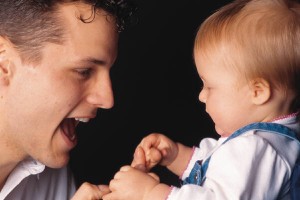
Much of learning and the way we communicate to others is done using words. Children’s brains need massive amounts of language stimulation in the early years. Just how much? Millions and millions of words. Some comprehensive research averages the number of words a child hears in just a year to be over 10 million. If a child starts school at age 4 that’s more than 40 million words.

How can parents and caregivers give early brains this word-nutrition? By including words in whatever you are doing! Talk, sing, tell stories, have face-to-face conversations with others, and when needed, talk to things.  For instance, when you discover a wet towel that somebody has left on the floor, you can say to the towel, “Hey Towel, what are you doing down here? This isn’t where you go. You go on the towel rod right over here. See? Doesn’t that feel better?” When you are cooking, ask the spoon if it will help you mix and stir. Change your voice to be the spoon and share how much you like to help.

Are those raised eyebrows as you read this? This seems to fall under the heading ‘out to lunch ideas’ . Think of one word as being equal to one penny and the brain as a brain-bank. Each word your child hears is a deposit. Would you rather your child has an account with 40 million deposits or only 10 million? When numbers get that high it doesn’t seem to make as much impact, so let’s take off the zeros. Would you rather have $1 in your wallet or $40? Maybe that’s a better comparison. Language is brain enrichment.

English may not be your first language or the language you use at home. Talk away in them both. English is not an easy language to learn so including it is very helpful before children start school and the family language is a special connection so talk, sing, and tell stories in it, too. (Of course, only 1 positive word is better than 40 negative ones.) Can you add many, many, many words to your child’s early learning?

Share this:
Share this page via Email Share this page via Stumble Upon Share this page via Digg this Share this page via Facebook Share this page via Twitter
Share

Kindergarten Readiness – Rock Solid Language Foundation

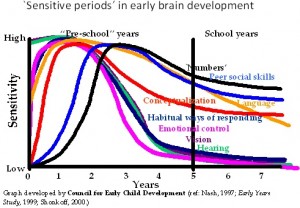
July means summer and holidays and holidays are an ideal time for some kindergarten readiness learning and fun. Helping your child develop kindergarten readiness can happen anytime. These early childhood years are peak sensitivity for all kinds of brain connections. Early development from 0 to 6 years is crucial for later learning.

No matter what the age of your child or the unique strengths and weaknesses you can give your child a rock-solid foundation for later learning by talking. Much learning happens in the context of language; the brain needs to hear lots of language to learn. This is something that can easily fit into regular and vacation days. Plus, it doesn’t take up any room in the car!

A study counted the number of words that children heard before they started school. Turns out it adds up to millions of words, at least 10-15 million! But for children in families that talked and chatted, with conversations like: “Oh, look at that big truck. That’s a moving truck. A family put all their chairs and tables and beds in the truck to take to a new place,” or “Look at that big puddle on the driveway. It rained so hard in the night I thought maybe we’d wake up this morning and see puddles made of rocks,” talking was much more. All this added up, over just 4 years, to a staggering 40 million words. Now that’s a rock solid foundation of language.

As your family works and plays this month, talk about where you are going, what you are doing, the things your child sees and hears, etc. Sing songs, tell stories, just use lots of language. Each word is a rock. Can you build a mountain of word learning for your child?

Share this:
Share this page via Email Share this page via Stumble Upon Share this page via Digg this Share this page via Facebook Share this page via Twitter
Share

Readiness for Kindergarten – And the word today is learning!

An inspirational site for the new year asked us to choose a word for 2012. That was easy for me…learning!

But better than 1 word is many. Would you believe more than 40 million many? That’s how many words a child has heard in the early years before going to school! More than 40 million words, isn’t that astounding? As the brain hears these all these words, it makes vast connections to figure out the order that words go in, what they mean, how they change when used with other words, the rules of the game and more. Words are really important for language development and kindergarten readiness. What are some of the ways we can include words and learning with kids?

  • Share books, lots and lots of books. Have Grandma Skype and she can read some.
  • Tell stories. We can remember a few that we heard like The 3 Little Pigs, Puss in Boots, and other traditional ones, but make up stories too with your little ones. “Once upon a time, the bus grew wings and …
  • Recite nursery rhymes, and change the words sometimes.
  • Sing, sing, sing. Make up your own songs to easy tunes. Listen to songs, too.
  • Talk with kids anytime. When it’s time to get dressed, talk to the socks. Making the bed needs some conversation, too: “Okay, pillow, you get to lie here nice and quiet and wait for bedtime. No hiding under the bed just under the covers.” Use voices for the fork and spoon at the table. Tell the shoes that they need to stay out of the mud unless they are boots.
  • Let kids hear grown-ups talking to each other. How else will they learn b i g words?

When it comes to readiness for kindergarten, language is significant. If words were pennies, think of them as deposits in your child’s brain bank account. And it can hold lots. Are you enriching your child’s word account?

Share this:
Share this page via Email Share this page via Stumble Upon Share this page via Digg this Share this page via Facebook Share this page via Twitter
Share

Readiness for Kindergarten – Pumpkin Hide and Seek

Some days have long lists of things to do and readiness for kindergarten may be lower on the priorities. But it is possible to combine readiness fun with other things. Remember yesterday’s song “Where is Pumpkin?” using the “Where is Thumbkin?” tune? Today for some kindergarten readiness fun let your little one hide the pumpkin anywhere in the room where you need to do something on your list. Then, you can “pretend” to find it and your child can hide it again. Or kids even like to find things that they have hidden themselves.

When children go to kindergarten, they will have to cope with instructions such as put their sweater in their cubby or put their boots on the shelf. They may have to locate something that is beside, under, above, below, etc. These words can be confusing so to understand kids need lots of experiences. Having heard these words and used them will stimulate their language development and help kids later at school. Hiding the pumpkin gives you and your child lots to talk about and is a fun way to practice. Where is the pumpkin? It’s under the chair, or between the cushions, or on top of the toybox, or in the bathtub. Silly pumpkin, why are you in the bathtub? It’s not bathtime…etc, etc.

A study released this week by the American Academy of Pediatrics (AAP) states “There is some scientific evidence that shows that the less talk time a child has, the poorer the language development is.”  So go ahead, ramble on about the pumpkin while you fold the laundry, do the dishes or tidy the bathroom. While your child is hiding the pumpkin under the bed, take advantage of the help to retrieve some of the things that are under it. Oh, oh…where is the pumpkin?

Share this:
Share this page via Email Share this page via Stumble Upon Share this page via Digg this Share this page via Facebook Share this page via Twitter
Share

Kindergarten Readiness – L=Language

Recently, I read the most amazing article. It was called The Early Catastrophe: The 30 Million Gap. The authors, Hart and Risley, compared the total number of words that children hear at home before they come to school. Of course, their study was based on a small amount of time and the numbers multiplied by hours, days and years but still the numbers are staggering. Children in professional families have had the stimulation of over 45 million words from birth to age 4 as compared to 26 million for those in working class families and only 13 million words for those children in families in the lower economic groups.  A gap of 30 million words. A child’s brain responds to stimulation so the difference of 30 million words is astronomic.

The letter l, today, is for language. Share lots of words and talk with your little one because it all adds up. Talk about where you are going, what you are doing, seeing, hearing, etc. Ask some what ifs, what if it was so hot the bus melted like chocolate, what if buildings went down instead of up, what if all the colors could talk what would they say. Wrap your day with language. It’s a treasure of immense worth for your child.

Share this:
Share this page via Email Share this page via Stumble Upon Share this page via Digg this Share this page via Facebook Share this page via Twitter
Share