Do you have a child starting kindergarten or school soon and lots of questions about readiness and developmental milestones? Here are some basics for kids to know that will help on their new learning journey.
As a kindergarten teacher, these are my answers to many parent and caregiver questions about what kids need to know. So often, we think of school as being an academic place, but it is so much more. For kids to feel comfortable and confident in this new world, they need a foundation of being able to take care of some basic needs and being able to connect with others. Sometimes, readiness is a ‘bad-word’ but really, we help kids be ready for things like a play-date, a sleep-over with a cousin, a visit to the doctor or dentist, a special trip or vacation and so much more. So, some readiness for kindergarten or preschool can help too.
Readiness activities for kids brings a big smile to some faces and to others an even bigger frown. But, we all like to feel ready for things: adventures, work, holidays, appointments, and more. Our own vacations start off better when we’ve got stuff prepped beforehand. No matter how ready we may feel for those days off, we don’t want to waste the least part of one just getting ready to go.
School is a whole new adventure for kids. Undoubtedly, we want the school to be ready to welcome our kids at their state of development and to avoid pushing and stressing our little ones. Just like grownups, kids can benefit from some adult help. The calendar above has some suggestions for ways we can support young children. For each day this month, choose one of these prompts and use it for a play activity. For instance, for “know my name,” some ways to play might be rolling out letters in play doughor finding different words that rhyme like Abby-Tabby. For naming emotions, make different kinds of faces at each other and guess that feeling. Pretending and imagining can happen with something as simple as a play cardboard box.
However you PLAY remember, this is the brain’s favorite way to learn. Isn’t a great bonus that it’s fun too? Of course, that could be Nature’s very clever and smart intention in the first place! Some readiness activities for kids sponsored by child’s play is a clever and brainy way of getting ready for life’s next big adventure!
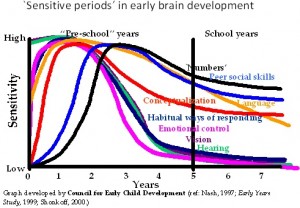
Chances are good one day in the future your child will go to kindergarten. Getting ready for kindergarten everyday is the best way and the best time is now. That’s because 90% of the brain develops before the age of 5. The graph below shows the window of opportunity. The high spots happen earlier than we imagine.
Sensitive Periods in Early Brain Development (Permission to reproduce has been provided by the Human Early Learning Partnership) (https://www.earlylearning.ubc.ca)
Getting ready for kindergarten is something you and your child can do every day. And the best news is, it’s not hard and won’t add to the to-do list. It’s as easy as 1, 2, 3.
#1. Fill the day with words. This can be singing, telling stories, sharing silly jokes, and having conversations. Kids need to hear millions and millions and millions of words to develop skill with language. Research estimates the number of words children’s brains process to be between 3 and 10 million a year. That’s just over 10 million words for some kids, and over 40 million for others. A gap of 30 million words. Think of your child’s brain as a sort of bank account for words. Would you want your child to have only 10 million or over 40 million? Enrich your child’s day with words.
#2. Read and share books and stories. This need only take a few minutes every day to add up to an entire library of books downloaded into your child’s brain account. Say you read 5 stories a day, a few days a week, about 25 books a week. Is that doable? Here’s how it adds up. 4 weeks a month makes 100 books. In a year, over 1000. By the time your child goes to school, there are 5000 books and stories ready in the brain. That’s a tremendous number of resources you have built up with just a few stories a day. And yes, one book that’s read a thousand times still counts.
#3. Whee. Kids absolutely need to move. Children’s bodies are growing on the outside and brains on the inside. Bodies and brains are a powerful team. Movement activities create special pathways in the brain. Kids use these for all kinds of thinking skills. On a sensory level, we need to engage the senses of touch, sight, hearing, taste, smell as well as the body’s position in space and the sense of movement. A child’s day needs space and time to move and be active.
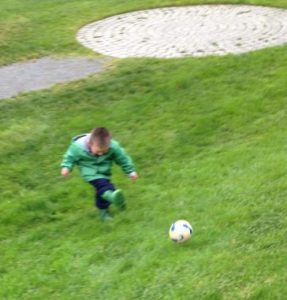
Finally, PLAY. Play is the brain’s favorite way to learn. Likely, your family is busy but kids don’t see the difference between work and play. Building with blocks is play to a child, but so is vacuuming. Floating a boat in the bathtub is play, and so is helping to wash dishes. You can include a few appropriate tasks for your child along with singing songs, reading books, kicking balls, making a blanket fort, and pretending.
Parents and caregivers are really children’s first teachers. Kids arrive at school with a learning foundation. Unfortunately, about one-third to one-half start school unprepared for the learning challenges. Could you use some help?
Each day, the 123kindergarten blog post is a play of the day. Check back each day for some Vitamin PLAY. There’s also a new video course with tons more play and learning suggestions. Doable, practical, child-tested and family friendly. Getting ready for kindergarten everyday really is as easy as 1, 2, 3, isn’t it?
Is Your Child Curious and Eager to Learn? As parents, if you were given a choice, would you choose being curious or being smart for kids? For success at school and life, kids need curiosity. Because kids always seem to be asking questions and wanting to know how something works, we overlook the critical importance … Continue reading Before I Go to Kindergarten #19: Kids Need Curiosity→
Are Communication Activities and Play Part of Your Child’s Day? More and more we are adding to the list of what’s important for kids beyond academics. Do you know how deeply communication skills impact kids? Some very recent research published in Science Daily has found that the level of language stimulation for young children … Continue reading Before I Go to Kindergarten #18: Communication Skills Impact Kids→
What’s so important about listening to stories and singing songs? Because language stimulation is critical for kids. Any language and every word. We all communicate to each other using language. While we also use gestures and facial expressions, we rely on words. Have you ever traveled to another country where you couldn’t speak the language? … Continue reading Before I Go to Kindergarten #17: Language Stimulation is Critical for Kids→
According to Einstein, “Imagination is more powerful than knowledge.” Therefore, a powerful activity for preparing kids for school is pretend play. We can’t see from the outside but as kids engage in pretend play their brains are seriously working. Brains are connecting different bits of information kids already know to actions and emotions. For example, … Continue reading Before I Go to Kindergarten #16: Pretend Play Helps Learning→
Every profession or trade has tools. For kids, those are crayons, paint, glue, scissors, etc. Kids need to play with school tools before kindergarten. Play is the work of the child. This earlier post has a description of some tools and how to use them: Once you have crayon-proofed, perhaps that should be kid and … Continue reading Before I Go to Kindergarten #15: Play with School Tools→
Are you wondering how the item: children’s independent play with toys can be a ‘requirement’ for kindergarten? How kids play gives developmental clues. Play on the outside reflects what’s happening inside physically, mentally, and emotionally. Let’s watch kids playing with puzzles. When kids first start playing with puzzles, they need large pieces made of wood, … Continue reading Before I Go to Kindergarten #14: Children’s Independent Play with Toys→
Are Letters a Familiar Friend for Your Child? Do kids need to know the alphabet before kindergarten? This is a common question and the answer is some basic familiarity with letters helps. In this video below, the parrot can say all the letters. Just because kids are able to say the names of the letters … Continue reading Before Kindergarten #12 Familiarity with Letters, Numbers, Rhyme Words→
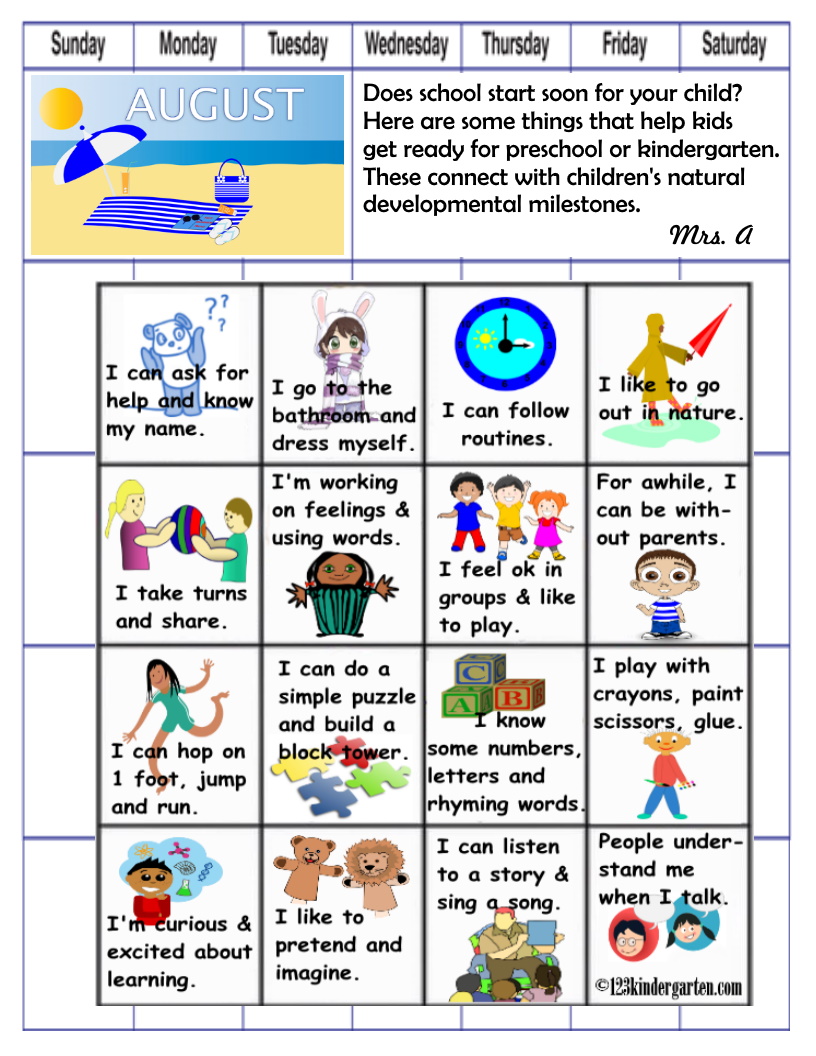
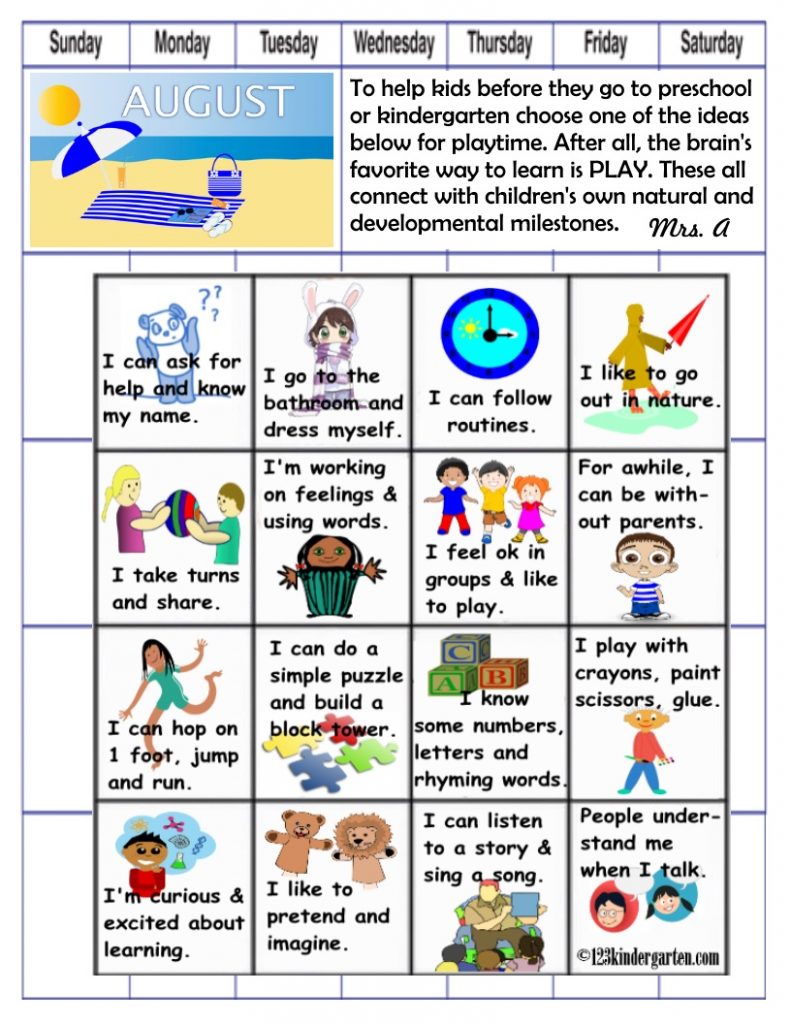 The calendar above has some suggestions for ways we can support young children. For each day this month, choose one of these prompts and use it for a play activity. For instance, for “know my name,” some ways to play might be rolling out letters in play doughor finding different words that rhyme like Abby-Tabby. For naming emotions, make different kinds of faces at each other and guess that feeling. Pretending and imagining can happen with something as simple as a play cardboard box.