Tag Archives: number activities

Kindergarten Readiness Countdown to Christmas

Christmas-calDid you know that setting up an advent calendar for counting the days to Christmas helps your child with kindergarten readiness? For children to develop their number sense they need lots of experiences with numbers.

Calendars are one way to practice seeing the numbers and saying them. It takes a great deal of repetition for children to be able to match the two accurately. A calendar show the number on the date increasing, but at the same time the number of days to wait are decreasing. This is a much harder math idea for older kids.

Calendars are also connected to time. There’s a new number only once a day, helping kids learn the idea of the length of a day. Your idea might be that the day is much longer for you than your child!

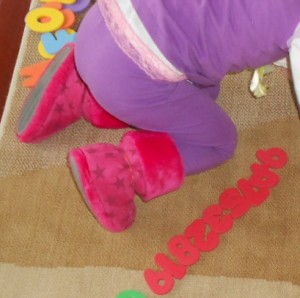
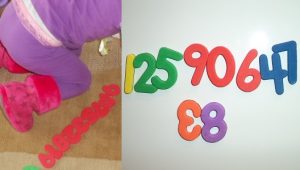
To increase the fun and learning, let your child play with some big foam numbers. Older children may be able to place them in order, while for younger ones, just putting the numbers all in a line is fun enough.

Are there some other ways to have fun with numbers today?

Share this:
Share this page via Email Share this page via Stumble Upon Share this page via Digg this Share this page via Facebook Share this page via Twitter
Share

Readiness for Kindergarten – A Tent for Number Ten

As children play and discover with numbers, they build all kinds of brain connections. These connections are important for number sense and readiness for kindergarten. The key words are play and discovery.

10t = tent

We had a very rainy day this week, too wet even for boots and umbrellas. It was an inside day all day long, and with no outside time it was long. A fun activity to do that I save for stuck-in-the-house days (to minimize wear and tear on the sofa) is making a tent. An old sheet draped over the sofa, with cushions as the ‘walls’, makes a space just right for a kidlet. The one here noticed that the number ten is like tent. Into the tent went 10 of all kinds of things: 10 books, 10 stuffies, 10 dishes, 10 animals, 10 little people, 10 cars, and 10 soft blocks. The rule is no sharp edges in the tent so there’s no holes in the sofa.

Not all the counting was accurate as you can tell in the picture but that’s okay. There was still lots of learning and fun. What’s important is the practice and experience. Accuracy will improve as children develop.

Almost a whole afternoon flew by with all the back and forth, counting, sorting, and hauling stuff to the tent. Adult hands were needed to fix the roof and to keep some of the toys in the toy box. This rainy day included lots of fun with 10! Do you sometimes make 10ts for your child?

Share this:
Share this page via Email Share this page via Stumble Upon Share this page via Digg this Share this page via Facebook Share this page via Twitter
Share

Kindergarten Readiness – A Bottle of Nine, Learning Vintage

So glad I saw this post at The Green Classroom about not throwing away plastic bottles. The idea is just right for some learning and readiness for kindergarten fun about the number 9.

Using an empty water bottle, find 9 objects that will fit inside but aren’t too small to get buried in the filling. Add some filler, like bean seeds, rice, corn or pasta. (Or, the hole-punch at work that no one ever empties would be a treasure trove of paper holes!) It’s important to leave some space at the top for the filler to move around. I took a quick picture of the 9 items and printed it off. Once I’d cut it out, I glued it to the bottom of the bottle. Now, the munchkin at our house can shake the bottle all around and look for the 9 treasures in the bottle. The picture shows what’s there to be found.

Bottle of Nine

Number sense is something that children develop from lots of exploration with numbers and counting. While older kids are ready to count the 9 items in the bottle, younger ones may not yet be able to hold that many of something in mind. They may only be interested in the hide-and-seek part. After experiences with numbers, they will gradually build up their understanding of “nineness”. Other ways, besides the bottle of 9, to help grow the idea of 9 might include having your child hop 9 times, put away 9 toys in the toy box, filling up a container of water while having a bath and pouring it out 9 times, making a line of 9 fishy crackers or 9 cheerios, etc. Will 9 blocks all stack on top of each other before they fall over? Do 9 cars fit in a tissue box garage? These are ways that your child can play and discover about 9.

Green-Classroom-Preschool-Play

Here’s the link to the post about bottles:

http://yourgreenclassroom.blogspot.com/2012/01/turn-plastic-bottles-into-magical.html

Does this give you some ideas about how to support and encourage your child’s number learning?


Share this:
Share this page via Email Share this page via Stumble Upon Share this page via Digg this Share this page via Facebook Share this page via Twitter
Share

Readiness for Kindergarten – Yummy Fun with 8

Now this is exploring numbers!! and when someone asks you what happened to 8, you just say you 8 it up!! Just found this yummy learning and kindergarten readiness activity on Deborah’s TeachPreschool blog using M & M’s.

http://www.teachpreschool.org/2012/01/exploring-mm-math-concepts-in-preschool/

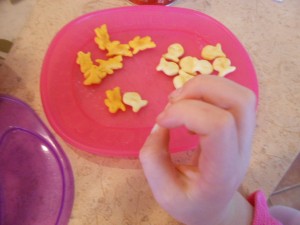
Using a bowl of small things like Cheerios, fishy crackers, Shreddies and M & M’s let your child count, sort and match.Which color has the most? How many purples are there? (None, there are no purple M & M’s.) Some colors make a really long line, some just a short line.

I made a quick chart for a pair of little hands to make lots of numbers. Lots of exploration of numbers is needed for kids to develop number sense. Some children may notice that as numbers get bigger and bigger lines get longer and longer as well. Others may see that each number is one more. Children will learn these concepts as they are ready by building on all their previous experiences with numbers. As kids make brain connections they are also developing readiness for what they will do in kindergarten.

After some counting fun, your child may just want to make some designs. This is part of number fun too. 8 (ate) is my favorite number. What’s yours?

Share this:
Share this page via Email Share this page via Stumble Upon Share this page via Digg this Share this page via Facebook Share this page via Twitter
Share

Readiness for Kindergarten – The Magic of 7

Why was the number 6 afraid of the number 7? Because 7 ate(8) 9!

While 7 isn’t a scary number, it does seem to be different from the others. It’s easy to work and play with smaller numbers and hands have a number 5 built right in. Dice, basic colors, small egg cartons and other things come in 6. 8 is easy to do, just tuck in the thumbs using 4 fingers on each hand and there is 8. All 10 fingers is a snap and 9 is taking only 1 away. But 7 is definitely tricky.

Some things do come in 7. There are 7 days of the week, Snow White and the 7 dwarfs, and 7 musical notes (do, re, mi, fa, so, la, ti, do). And 7 can be magical. Once children grasp how many is 7 –”sevenness”–  it seems that they have figured out how numbers work and they learn more numbers much quicker. I have not found any research to support this; it is my own observation from working with little ones.

exploring numbers

7 plus a few more

Like other readiness for kindergarten skills, your child may or may not be ready to connect 7 with it’s quantity. Some play and discovery with 7 will give your child experience with this number and help build understanding and number sense. Ways to explore 7 might include counting 7 buttons on a shirt, making a tower of 7 yogurt containers (more might show up), or putting 7 spoons in the dishwasher. You may want to wear off some energy by asking your little one to jump 7 times or hop. Is 7 giant steps enough to go from the kitchen to the bedroom? How far can your child go taking 7 baby steps? 7 slices of banana may be just right to eat.

Kindergarten readiness grows over time, just like our kids do. And isn’t it magical how children develop and learn? What magic did you do today with 7 or other numbers?

Share this:
Share this page via Email Share this page via Stumble Upon Share this page via Digg this Share this page via Facebook Share this page via Twitter
Share

Readiness for Kindergarten – Learning That Stix with Six

I knew I had a couple of empty egg cartons but I couldn’t find them earlier today. I saw this handy hint of using them to hold breakable Christmas decorations so they are already stored away. Luckily I found something else to use for number 6–a muffin baking pan–for this learning and kindergarten readiness idea.

Exploring numbers is a fun activity for little ones about age 2 and up. Lots and lots of experiences are needed for children to build their understanding of numbers or number sense. A muffin tin, small egg carton or half a big one are perfect for discovering “sixness”. How many is 6? Let your little one put 1 block in each section. That’s 6. Your child can dump them out and try it with 1 animal in each part. Another 6. Toy cars, action figures, playdough balls or other small objects can be used as your child makes groups of 6.

Your child may be not be able to correctly count to 6 but just putting an item in each space and seeing what 6 things look like together will build brain connections and readiness for kindergarten. Just playing with toys and naming numbers is a beginning. Older kids may be able to count 6. Math whizes may count out 6 of one kind and 6 of another and notice that makes 12. Offer some groups of things that have more than enough–like bottle caps. Are there enough keys? How about erasers? Kids learn as they play and discover.

Some other ideas to suggest to your child might be to hop, spin, or jump 6 times. Take 6 giant steps, 6 baby steps, or 6 dinosaur steps.  Tuck 6 toys in a toy box. Put 6 shoes or boots on the shelf by the door. 6 stuffies are having a nap. Is anybody else sleepy?

Share this:
Share this page via Email Share this page via Stumble Upon Share this page via Digg this Share this page via Facebook Share this page via Twitter
Share

Readiness for Kindergarten – 4 Gr8 Learning

Learning about numbers doesn’t start with printable worksheets; it starts with exploring numbers in play and using them at home. These experiences all contribute to children’s number sense (and readiness for kindergarten) which grows and develops just like kids do. What are some fun activities for the number 4?

Cars, trucks and lots of train pieces have 4 wheels. As your child plays with a car, count the wheels 1..2..3..4. You can notice that other cars have 4 wheels, too. Are there any other ones with 4 wheels? If you have a plastic placemat, “park” one car in each corner. There are 4 cars, there must be 4 corners. Have your child make groups of 4 objects using stuffies, blocks, cars, even shoes. Sing The Wheels On The Bus, but buses do sometimes have more than 4 wheels. Hop 4 times, then have your child jump 4 times, sit down and stand up 4 times. Play some hand clapping games together with your child (see blog for #2, two days ago).

The following activity can be done as you need to do some chores: go on a 4 walk in the house. Look for things that are 4, like chair legs. Check under the beds to see if they have 4 legs, retrieving items or even dusting.  Pick up 4 toys, put 4 things away. Read 4 books; they can be short. Besides, you and your child need some sitting time after all that work. Maybe 4…maybe 1 cookie, in four bites?

Using numbers in ordinary and play activities will help your child understand “fourness”. Number sense is not just counting numbers in order, it’s figuring how many items belong to each number. This is the basis for later math. Children will do lots more number activities when they start school. Supporting kids number learning earlier promotes kindergarten readiness and helps them feel successful in later math activities.


Share this:
Share this page via Email Share this page via Stumble Upon Share this page via Digg this Share this page via Facebook Share this page via Twitter
Share

Readiness for Kindergarten – 1 2 3 Go, Play, Learn

1,2,3…Go! While many children can say the number 3, they also need to build in their mind an idea of “threeness”. To do this, kids need lots and lots of experiences with 3. Over time, they create a mental image of how much is 3, linking how many to the number word. This basic understanding or number sense is very important for kindergarten readiness and all other math learning. Plus, they will do lots of number exploration at kindergarten, too.

Today’s readiness for kindergarten pre-math activity is exploring 3. If appropriate, ask your child to put 3 blocks or cars in a line, find 3 stuffies, 3 books, etc. Younger kids may not be able to, but together you and your child can count 3 things a few times. Then, let your munchkin play with the items. Older kids may be able to make 2 or 3 different groups of 3 things. Do they have the same number of objects? Yes, 3 is always 3. Is there a special shape that’s like 3? A triangle. Why is it like a 3?

Setting the table is a 3 activity: knife, fork and spoon = 3. Put away 3 toys, read 3 books, eat 3 things, do 3 actions–hop, skip, jump. Take 3 giant steps, 3 baby ones, 3 medium ones.There’s lots of books about 3 and some stories to just tell, like  The Three Bears, The Three Little Pigs, The Three Billy Goats Gruff. Sing 3 Little Kittens Lost Their Mittens. Make up some new animals: 3 little bunnies lost their honey, 3 little frogs lots their logs, 3 little llamas lots their mamas. Oh, no!! What’s your child’s favorite number? Is it 3?

Share this:
Share this page via Email Share this page via Stumble Upon Share this page via Digg this Share this page via Facebook Share this page via Twitter
Share

Readiness for Kindergarten – 2 Times the Number Fun

Each day will have untapped opportunities for learning activities. From first thing in the morning until bedtime here are some ways to build and reinforce your child’s understanding of the number 2 (and promote readiness for kindergarten later on). Some will be more appropriate for younger toddlers and some more appealing to older kids.

Getting dressed, you can ask your child to find some pants with 2 legs and a shirt with 2 arms. What would happen if we had 4 arms? Count feet-how many socks and shoes? For older kids, have them add your feet as well, now how many feet? That’s called counting by two. Hop on 2 feet, share 2 hugs, use 2 hands at the table.  If you are on your way out listen with 2 ears and watch with 2 eyes. In the car, sing 2 songs. Older kids can count all the twos! There are stories about 2: 1 Fish, 2 Fish, Red Fish, Blue Fish by Dr. Seuss, or read 2 books 2gether.

Your child might like to choose 2 cars to play with, or make a duplo robot that has 2 heads, or play with 2 stuffies. Might you have 2 colors of playdough at home? If you are lucky enough to have a minute or two when you are sitting, you and your child can play some games that use 2 hands. For little ones, place your hand on the bottom, your child places a hand on top of yours; then your other hand and finally your child’s. Slide your hand out from the bottom and put it on top again, then your child takes a turn. For older ones, try some clapping games; first each person claps hands, then high fives together, then each person claps once and together again. Make up some of your own clapping games. 2 hands can have lots of fun on a drum–or maybe not. Wash 2 hands for supper.

Your child will find other things that are 2 that appeal to him or her. While simple, these activities all work together to build important brain connections for understanding numbers. This helps with kindergarten readiness but more importantly develops number sense. What else can you suggest for kids to do for exploring twoness?


Share this:
Share this page via Email Share this page via Stumble Upon Share this page via Digg this Share this page via Facebook Share this page via Twitter
Share

Readiness for Kindergarten – Fun Activities With Number 1

Children need to develop a basic number sense. While lots of experiences with numbers is important, for some kids developing number sense is easier than for others. This may be related to learning styles. Following are some fun activities with the number 1 that appeal to different learning preferences and will help with basic number sense and readiness for kindergarten, too.

  • For kids that seem to learn best by action: Ask your child to hop on just 1 foot. Reach way up high with only1 hand. How high can your child build 1 tower with lots of blocks? Or maybe the blocks might like to be 1 robot. Wow, did you know that a body can be like a number 1? A number 1 is like a line, standing up or on the floor. It’s easy to roll playdough into a number 1 shape.
  • For kids that seem to learn best by seeing: When your child is playing, you may want to “place an order” for 1 car, 1 stuffie, 1 block. Your child sees what represents 1  in all kinds of ways. Put 1 plate on the table or look for 1 blanket for a pretend picnic.  A rain stick looks like a number 1, too.
  • For kids that seem to learn best by hearing and talking: Maybe read a story about 1, like 1 Gingerbread man. Or tell a story about 1. Sing 1 song–at a time. Old Macdonald had lots of animals, but he was just 1 farmer. Play 1 instrument.

Doing lots of different kinds of activities–action, seeing and hearing–will also help kids practice other learning styles as well as developing their understanding of  the number 1. This builds both number sense and brain connections for kindergarten readiness.

It’s not much fun, though, to eat just 1 cookie…unless it is very, very big. Can you and your child have a 1derful day?


Share this:
Share this page via Email Share this page via Stumble Upon Share this page via Digg this Share this page via Facebook Share this page via Twitter
Share