Category Archives: Math Activities

Kindergarten Readiness: Pretzel Fun and Learning

Pretzels can be used for counting, grouping, pretending and other kindergarten readiness fun and learning activities. Pretzels never came in all those fun sizes a few years ago. Now there are even bunny and carrot shaped pretzels.

simple math with pretzelsNo matter what shape pretzels there are at your house, kids can use them for some simple math. Line a few pretzels up to count. How many pretzels are there? If you had 3 pretzels and then 1 more now how many? If there are 6 pretzels on a plate and 2 jump in your mouth, how many would be left? Pretzels can be pretend restaurant food or a snack for a dinosaur, just in case there are any playing.

my-daddy-is-a-pretzelSpeaking of snack, there are some really cute edible ideas with pretzels, like straight ones stuck in alternative-to-peanut butter to make a spider, or two stuck together to make a butterfly. Pretzels, seeds, craisins, and cheerios can be mixed in a little dish and kids can sort them into groups and then eat them up.

Pretzels are all twisted together. To get little ones moving, ask them to make some pretzel shapes, like a twisty pretzel, a straight one, a pointy pretzel, or a circle. There is a children’s book about yoga called My Daddy is a Pretzel, by Baron Baptiste. As kids make the shape of an airplane, lion, bridge, pretzel, and more, they are doing some yoga poses. What other fun can your child have with pretzels?

Share this:
Share this page via Email Share this page via Stumble Upon Share this page via Digg this Share this page via Facebook Share this page via Twitter
Share

Kindergarten Readiness: Picking Dandelions Math Fun

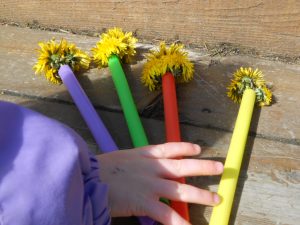
A play-of-the-day came with the unplanned spring activity of picking dandelions but it had some powerful learning and simple fun. When my 4 year-old helper came with me to a friend’s house, we had some tea at the table and noticed a package of bubble-tea straws, the really big ones.developing kindergarten readiness and early learningFour colors of straws came home with us. On our way to the car we stopped to pick some dandelions while Lee clutched the straws in her hand.developing kindergarten readiness and early learning
Needing somewhere to put the dandelions she slid them into the straws. Three dandelions filled the first straw, then another 3 were added to another straw. Content with her own plan, she carefully chose just the right flowers and just as carefully made sure each straw had 3. Proudly she showed me all four.developing kindergarten readiness and early learningUsing the opportunity, we counted each straw and yes there were 3 dandelions. Then we put them on the step and counted them. To make it easier, I put 2 straws on the left and 2 on the right. It was easy to see 3 + 3 making 6 flowers. That was enough, it was time to go.
developing kindergarten readiness and early learning This brief activity of making groups with straws and flowers may soon be forgotten, but these early kinds of experiences will create the foundation for learning the math concepts of addition, multiplication, and division farther down the road. This was definitely child-led play with a teachable moment.

developing kindergarten readiness and early learning

There may be some of these moments at your house today. Can you and your child make some groups of things for fun and learning?

Share this:
Share this page via Email Share this page via Stumble Upon Share this page via Digg this Share this page via Facebook Share this page via Twitter
Share

Kindergarten Readiness – Conversations with Guest Experts #4

For each radio show on Learn and Play with Mrs A, I take notes because I’m learning so much about kids and kindergarten readiness from fascinating guests who are experts in a variety of areas. Each of them is passionate about kids and loves the work, or maybe that’s play? Here’s a play-of-the-day suggested from our play-of-the-week conversations and a little information about these awesome guests.

math activities for kidsWhile math is not magic, educator and speaker, Cathleen Alexander added “…but it is magical.” So was a conversation with her about kids and math! She reassured us that kids do not need to be born with a math gene; instead, they need to have lots of fun experiences with math. One activity that she suggested was ‘story problems on a plate. For these, you and your child can use cookies, cereal, crackers, etc. For example:

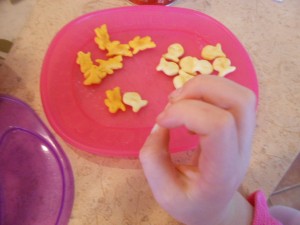
Put a few fishy crackers on a plate. Together you and your child can count them. Put some Cheerios in a small line. What happens if you each eat one, how many are left? One cookie and one cookie, and now there are how many cookies? Oops, how did there get to be none?

Here’s a link to the podcast with Cathleen Alexander on kids and math:
Cathleen Alexander/Learn and Play podcast

Share this:
Share this page via Email Share this page via Stumble Upon Share this page via Digg this Share this page via Facebook Share this page via Twitter
Share

Kindergarten Readiness: Football for Number Learning and Fun

Did you know that football can help promote kindergarten readiness? Many homes had football on their tvs this weekend, and football certainly has numbers. There are numbers on jerseys, numbers on scores, big numbers on the field and more. Lots of experiences with numbers, in a variety of situations is what children need to build their understanding of numbers and other math concepts.
Football Team in a Huddle
Just learning the words for numbers can be quite a challenge, let alone being able to name them in order. Then, number words need to get connected to how numbers look. There’s a lot of brain connections that need to be made for learning numbers. Children need to hear the names of numbers over and over again and see what they look like. Reading books about numbers, singing number songs, counting the steps and stairs, looking for numbers in signs and displays, and even watching football are ways for kids to encounter numbers.

Are there some ways that you can include number fun and learning for your child again today?

Share this:
Share this page via Email Share this page via Stumble Upon Share this page via Digg this Share this page via Facebook Share this page via Twitter
Share

Some Handy Ideas for Kindergarten Readiness: Counting

1 little, 2 little, 3 little fingers can all be used for counting which is another kindergarten readiness learning and fun activity. Counting can be done anywhere and at anytime. Not only is counting an early math skill, it is also the base for number sense. As children repeat the experience of counting over and over again, they begin to understand that one number counts only one item. This seems so obvious to us, but remember math is new to their brains and it takes lots and lots of counting practice for little ones to match one number and one object. After practicing counting, they figure out how many objects belong to each number.

countingChildren use their fingers for counting by pointing at or touching objects. Later, they will their fingers to help with mental adding or taking away. Even adults will sometimes still use their fingers. Try adding up how many family members will be at a big meal and you will probably be counting on your fingers.

Aren’t hands handy? So far this month, hands have helped kids with all kinds of learning: singing, developing fine muscle skills, building, painting, drawing, playing in sand and water, talking with puppets, connecting with nature, crafts, exploring humor, and counting. What else can hands do?

Share this:
Share this page via Email Share this page via Stumble Upon Share this page via Digg this Share this page via Facebook Share this page via Twitter
Share

Kindergarten Readiness And Olympic Numbers

Today, kindergarten readiness goes to the Olympics for some number fun and learning. The Olympics may be the sporting event of the world but would it be possible without math? Scores, measurements, time, laps, points – it all needs math.

count-numbersNo matter if your child already knows numbers or not, all kids can benefit by noticing the different ways we use numbers and math in a day; this is called environmental math. Every time someone in your family notices numbers or uses another math idea, pop a counter such as buttons, pennies, or macaroni into a container. Checking the time, comparing sizes or figuring out how much of something there is will all count, too. The more ways you use math, the more counters in the container. Watch the total grow and grow. (Smarties will also work but it’s hard to wait to eat them.)

How full is your math-in-the-day container? Math really is part of every day in ways we do not usually notice. Math wins the Gold Medal! How many times did you use math today?

Share this:
Share this page via Email Share this page via Stumble Upon Share this page via Digg this Share this page via Facebook Share this page via Twitter
Share

Kindergarten Readiness Rocks! 1 to 1 Correspondence

Rocks may not seem like an educational material for early learning but just a few stones are needed for some kindergarten readiness math fun.

As children sort out that numbers mean ‘how many’, they begin to count. Have you ever noticed that as they learn, they count somethings more than once, sometimes over and over? In order for children to count, they need to figure out that one number goes with one thing.  This is called one-to-one correspondence and is a basic math concept. Being able to match one item to one number is a key to understanding how the number system works. Children may be able to say numbers in order but may not necessarily figure out that each time they count that means one more. Kids need to understand this 1-to-1 relationship first so they can link one number and one object.
rock-five
For kids to grasp this idea they need to have lots of play experiences with one to one matching. Since the rocks were out, it was easy to ask Lee to make a rock family just like her family. She needed a rock for mommy, daddy, herself and baby sister in the shoebox lid house. But there were five –another one for the cat! Math is about numbers but it is also about relationships. Using one rock to be each person in the family was creating a relationship, too. (Rock families will all be different.)

rock-oneThere are other ways to play with 1 to 1 matching. How many toes are on a foot? One rock for each toe, or one rock for each house; in this case it was one rock. As your child is able, you can make some easy or harder suggestions. One rock for each wheel on the car, one rock for each chair in the kitchen, one rock for each nose, etc. What happens when it’s one rock for each eye? Kids will think of their own ideas for matching (and mathing). Are there some rocks that your child can use for kindergarten readiness fun and learning?

Share this:
Share this page via Email Share this page via Stumble Upon Share this page via Digg this Share this page via Facebook Share this page via Twitter
Share

Kindergarten Readiness Rocks! Rock Patterns

Kindergarten readiness develops as children play with what is around them, in this case it’s rocks. Rocks are fun to use to make repetitive patterns. A pattern is some objects that are repeated in the very same way. Learning about patterns is not just a readiness for kindergarten skill, it’s a fundamental skill for all learning. Plus, it will help to build higher level thinking, memory, and problem-solving skills. Kids need lots of experiences with patterns and lots of repetition. Patterning will be a skill that kids explore at kindergarten, but lots of experiences will help children develop their patterning abilities. One of their early patterning activities is crawling/walking; left-right, left-right, left-right is a pattern.rock-pattern

Two colors of rocks are easy to put in a pattern: grey-white, grey-white, grey-white. Or, in a color pattern (more or less) like these rocks. sometimes, patterns can have 3 parts: blue-purple-brown, blue-purple-brown. To start, you will need to put the rocks in a pattern and have your child “help” you figure out what comes next. You might need to supply the answer, too. Your child may be able to finish more complicated sequences and make his/her own patterns.


Some children catch the idea and some may need lots more fun with patterns before they understand. Just a quick look around your place will reveal lots of patterns; the bathroom tiles, the afghan on the bed, towels, dishes, furniture, clothes and more. Not only are these patterns in items we make, nature is full of patterns, too: butterfly wings, weather, bird migration, beehives, etc. Language has patterns, and music, math, and science, too. Pattern experiences here and there with your child will help  build pattern brain connections. What patterns can you and your child find or make today?

Share this:
Share this page via Email Share this page via Stumble Upon Share this page via Digg this Share this page via Facebook Share this page via Twitter
Share

Kindergarten Readiness Rocks! Learning About Sizes

Putting small rocks and little kids together can add up to big kindergarten readiness learning and fun. Learning about size can be a tricky concept for children.

rock-sizesSize is all about relationships, rather than the bigness or smallness of something. A child’s play table can be small, but it’s pretty big when compared with doll-house furniture. A sweater can be too big for a baby or too small for an older brother or sister but the sweater hasn’t changed it’s size at all. No wonder the brain has a challenge figuring out sizes. Young children need lots of exposure to size words and and lots of play experiences to understand how size works.

rock-stackPlaying with rocks can be fun for a child and help with size relationships. As your child plays, you may be able to find 2 rocks of different sizes and ask which one is big and which one is small. Use a third rock and ask now which one is big, now which one is small. Did it change? How did that happen? Did the rock grow? Try a few more and some different ones. It also seems like magic, that a rock can be the small one in a group and next time it might be the big one.  Your child may want to simply play with the rocks, or may put them in order as to size. Either way, the brain is making connections, learning and having fun. Do you agree that it’s no wonder kindergarten readiness rocks when playing and learning can be so much fun?

Share this:
Share this page via Email Share this page via Stumble Upon Share this page via Digg this Share this page via Facebook Share this page via Twitter
Share

Kindergarten Readiness Rocks! Counting Rocks

For some very inexpensive kindergarten readiness math fun and learning for young children, use rocks. Usually, rocks are quite easy to find and they can be fun to count. When counting, as you can, help your child point to or touch only one rock at a time. They will make mistakes as they learn how to count.
rock-counting
Counting is one of the first math skills that children learn, after they learn the names of numbers, that is. While kids may know the numbers in the right order, that does not mean they understand about counting. While it’s obvious to us, children need to learn that one item goes with one number. As we count, we are counting only one thing at a time. This is part of number sense and lots and lots of practice is needed just counting in order for kids’ brains to develop this basic understanding of numbers.

As children play, they develop their number sense and gradually figure out how many items belong to each number. If appropriate for your child, s/he may be ready for some early problem solving, too. Because children learn at different rates some will be able to count higher than others. Math activities will certainly be part of the lessons and play at kindergarten but the more experiences and play kids have with numbers before arriving at school the better will be their foundation. Does this activity count with you and your child?

Share this:
Share this page via Email Share this page via Stumble Upon Share this page via Digg this Share this page via Facebook Share this page via Twitter
Share