Category Archives: Art/Music/Drama Activities

Kindergarten Readiness: Pre-printing That Really is Fun!

“What about if my child just isn’t interested in printing or anything like that; ” asked a parent at a kindergarten readiness evening, “so what can I do?” The answer to that is easy: Make it Fun!! Printing activities can be appealing to children, just check all the walls that have been decorated by children’s art work. Printing starts with lines, scribbles, dots, and other marks. Here are some suggestions for tools and materials that kids can play with to develop both the coordination that will be used and the interest. Instead of paper and crayons, your child might like:pre-printing activities

  • felts on coffee filters that are sprayed with water to make color puddles
  • paint dabbers on anything that grownup hands can cut into dinosaurs, fish, crowns or anything elsepre-printing activities
  • pails of water and big paintbrushes for “helping” to wash the driveway or car
  • chalk on the sidewalk
  • plastic eye-droppers and little containers of ketchup for putting drops on food (surprisingly, this uses less ketchup than dipping)
  • q-tips and food coloring on cut-up cereal boxespreprinting activities
  • a big wooden spoon making roads in the sandbox

These are just a few ideas and, after you try some, you will find that you can think of even more.  Some of these activities will keep kids engaged for longer periods of time than others–carrot sticks that paint dip in a bowl get eaten fairly quickly–but even if it’s only for a minute or two, those minutes will add up to quite a few during a week or a month. When the time comes for using writing tools and trying some printing, it is much easier because kids are comfortable with the action of holding something to do something. Brain connections are developing for coordinating fine motor skills. The new intention is based on previous play. Are these doable activities to try with your child?

Share this:
Share this page via Email Share this page via Stumble Upon Share this page via Digg this Share this page via Facebook Share this page via Twitter
Share

Kindergarten Readiness: Pat-a-Cake & Hand Clapping Games

Pat-a-cake and other hand clapping games are a fun little activity for learning, play, early brain development, and kindergarten readiness. They can be simple for babies or complicated enough to challenge older kids, and even adults! Just looking at a few on youtube will astonish you. This was the simplest one I could find and the only person who makes a mistake is the dad.

The value of these games is the brain exercise. The brain itself has 2 halves, and so do our bodies. Think of a line that divides our entire self into a left-side and a right-side. This imaginary line is called the mid-line and as we cross the mid-line with a part of the body, the brain also starts to cross connect. The pathways that form help the 2 halves of the brain connect and work together. Babies and young toddlers will reach for an object on the right side with the right hand and for something on the left side with the left hand. As the brain wiring crosses, little ones develop actions that cross, such as rolling over and later crawling. Learning benefits of clapping games include concentration and focus, listening to and watching a partner for cues, using a pattern, stretching memory, following rhythm, coordinating actions and speaking, to name just a few.

Pat-a-cake is a very simple pattern. Parents and caregivers can show little ones to clap hands and then legs, for a harder pattern. This is the pattern used in the popular “Who Took The Cookie From The Cooke Jar.” This can be done by 4 and 5 year old children. Some will clap the pattern, some will say the words, some won’t do either and a few will be able to do both together.

Coordinating with a partner gets even trickier as hands first clap together and then they clap the partner’s hands, back together and then partner’s again. These are not just games for girls; many videos show boys as well. Teenagers even do them. While many of these are much too hard for preschool kids (and I’ll confess, I couldn’t do them) there are easier games. For a play-of-the-day can you show your child some hand-clapping games?

Share this:
Share this page via Email Share this page via Stumble Upon Share this page via Digg this Share this page via Facebook Share this page via Twitter
Share

Kindergarten Readiness: Peel Bananas for Fun & Learning

Today’s kindergarten readiness play-of-the-day for fun and learning is going bananas. Have you heard the Peel Bananas rap? There’s a Youtube video of it below. The words are simple and the rhythm very catchy.

rhythm learning activitiesBananas, u-nite!
Peel bananas. Peel, peel bananas.
Slice bananas. Slice, slice bananas.
Mix bananas. Mix, mix bananas.
Eat bananas. Eat, eat bananas.
Go bananas. Go, go bananas.
Go bananas. Go, go bananas. Banana SPLIT!

There are other verses you can make up if you are making banana cookies (smoosh bananas) or smoothies (blend bananas) or covering them with peanut butter and nuts (roll bananas). This appeals to very young children and older ones. Children’s brains are familiar with rhythm from before birth with the beating of the mother’s heart. For all of us, there is the rhythm of breathing. Nature has a rhythm with day/night and the seasons. Each and every language has a unique rhythm. Both music and math have rhythmic patterns.

Rhythm, like other patterns, helps for learning and memory. The underlying rhythm of the Peel Banana rap will help children remember the words. As groups say it together, kids are learning to listen for clues, matching themselves to others, and experiencing how it feels to be part of the group, like the bananas in a bunch. Can your child Go Bananas?

Share this:
Share this page via Email Share this page via Stumble Upon Share this page via Digg this Share this page via Facebook Share this page via Twitter
Share

Kindergarten Readiness: Painting for Fun and Learning

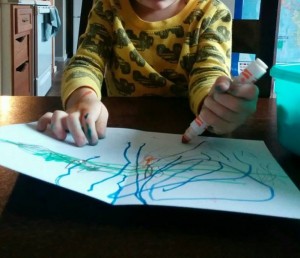
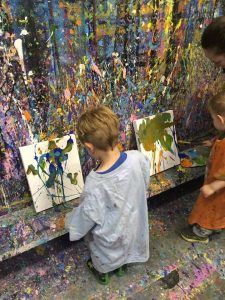
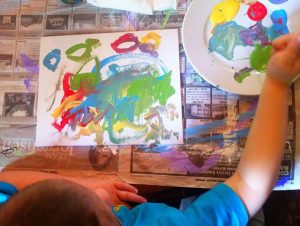
fridge-artJust in case your fridge isn’t totally covered with art work, today’s play-of-the-day that starts with a p, like A pril, for some kindergarten readiness fun and learning, is a painting activity. Kids can paint with anything: brushes, hands, feet, fingers, marbles, wheeled toys, q-tips, rollers, dabbers, and salad spinners. Paint can be practically anything too: food coloring, water paints, candies soaked in water, fruit juices, and vegetable peels. Things to put the paint on do not have to be limited to paper, either. But whatever kids use for tools and colors, there are some great ways to have fun and learn.

As children are painting, they are:

  • experimenting with ways to express themselves and their creativity,
  • exploring their own ideas and stretching their imaginations,
  • strengthening small muscles in the fingers, hands, and arms,
  • building concentration and attention skills,
  • practicing making pictures on paper and in their minds (visualization),
  • discovering what happens when colors are mixed together,
  • learning new vocabulary such as lighter or darker, swirls, zig-zag, even, etc,
  • and extending language to explain what they are doing.

painting activities with kidsOne of the surprising aspects of painting that kids learn is when to stop. Too much paint and water turns all the colors muddy or worse, makes holes. But these experiences are also part of the learning. When all done, kids can help tidy up and put things away, practicing responsibility. These are only some of the early learning and readiness skills, there are certainly more. What kind of painting fun and learning activity can your child do today?

Share this:
Share this page via Email Share this page via Stumble Upon Share this page via Digg this Share this page via Facebook Share this page via Twitter
Share

Kindergarten Readiness – Conversations with Guest Experts #2

For each radio show on Learn and Play with Mrs A, I take notes because I’m learning so much about kids and kindergarten readiness from fascinating guests who are experts in a variety of areas. Each of them is passionate about kids and loves the work, or maybe that’s play? Here’s a play-of-the-day suggested from our play-of-the-week conversations and a little information about these awesome guests.

Music impacts children’s learning and development at a deep level, even before they are born. Richard Leighton is a musician, songwriter, performer, producer, and advocate of music as a crucial part of children’s development. With a store/classroom his passion is to bring music into the lives of more and more children and he is accomplishing it everyday.
importance of music for children
Here’s a play of the day from Richard, making a shaker with a plastic bottle and pebbles. Rhythm is hard-wired into our systems with heart beat, pulse, breathing, day/night cycles and more. Babies will like shaking and making noise, toddlers can create simple rhythms and older kids can explore more complicated ones. (***BE sure the lid is glued on so the rocks don’t escape.) What rhythms will you and your child create?

Richard Leighton’s facebook page is:
https://www.facebook.com/arbutusmusic
and here is the podcast download link: Richard Leighton/Learn&Play podcast

Share this:
Share this page via Email Share this page via Stumble Upon Share this page via Digg this Share this page via Facebook Share this page via Twitter
Share

Some Handy Ideas for Kindergarten Readiness: Crafts

When little hands do crafts they are also doing lots of learning, as well as having fun and playing. These are some of the strategies and skills: crafts

  • organizing, deciding, trying different options
  • fitting, matching, placing, planning
  • cutting, gluing, coloring
  • learning to use art/writing tools
  • talking, explaining, using related words and vocabulary
  • problem-solving, comparing, evaluating, counting
  • using and caring for different materials, cleaning-up

Children are also developing their fine-motor skills and eye-hand coordination. They are nurturing their own creativity and taking pride in their accomplishments. Not only can their hands be proud of their work, but so can their hearts and minds. Oh, how could I forget the pride of their parents and caregivers, too? What crafts does your child like to do?

Share this:
Share this page via Email Share this page via Stumble Upon Share this page via Digg this Share this page via Facebook Share this page via Twitter
Share

Some Handy Ideas for Kindergarten Readiness: Drawing

Instead of Drawing on the Right Side of the Brain, for some kindergarten readiness learning and fun draw on some paper. (You are allowed to groan at that joke if you remember the book by that title.) Drawing can help the development of brain connections and small muscle control.

hand-artThis is a drawing of a hand. Tracing around a hand with a felt marker will leave a line on paper and on a hand! Drawing is also great practice for attention and focusing skills. As children draw, they are playing, stimulating imagination and representing what they see around them. Pictures on paper encourage visualization, that is creating pictures in the mind.

After your child draws a picture of a hand, you can print the word hand underneath and  then read it together. This helps your child understand that written words on a page have meaning. While this seems obvious to us, it is something your child has to figure out for later learning to read.

Talk about colors, too. Isn’t this quite a handful of early learning? And lots of fun?

Share this:
Share this page via Email Share this page via Stumble Upon Share this page via Digg this Share this page via Facebook Share this page via Twitter
Share

Some Handy Ideas for Kindergarten Readiness: Drums


Hands can make all kinds of rhythm and rhythm makes all kinds of brain connections for early learning and kindergarten readiness. Drumming is a favorite activity for young children. Pots and pans and wooden spoons can make just as satisfying a sound as a real drum.

As far as rhythm goes, it’s no wonder that kids like to explore and create rhythm. After all, it’s pretty basic. Just think of such natural rhythms as heartbeats, breathing, walking, running, and language.

drum-funDrumming uses some basic musical concepts, too like fast, slow, loud and soft. If you and your child each have a drum, you can play a very simple rhythm which your child can copy, like an echo. This is very helpful for kindergarten readiness, because it encourages careful listening and attention. Rhythm also encourages both physical and mental development.  It’s not easy to coordinate movement to a beat.

You may need to use some earplugs and have a Plan B. Do you agree that, usually a few minutes of drumming goes a long way?

Share this:
Share this page via Email Share this page via Stumble Upon Share this page via Digg this Share this page via Facebook Share this page via Twitter
Share

Some Handy Ideas for Kindergarten Readiness: Painting

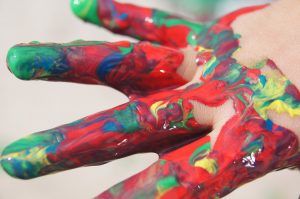
Kids love using their hands to paint and painting is definitely a kindergarten readiness learning and fun activity. Adults think of paints and crayons as tools for creating art. For kids, paints and crayons are more than that. They are tools for discovering and learning through play.

What are some of these learning and kindergarten readiness activities?  Fine muscle control and eye-hand coordination. are the most obvious skills developed, helping little ones with writing tasks later on.

  • Creating with paints and crayons is also a form of self-expression as kids explore what they like and don’t like. They explore their own ideas and exercise their imaginations.
  • They are also building the understanding that images on paper have meaning; this is a basic concept for both reading and writing.
  • As kids talk about what they are doing and practice words such as more, darker-lighter, bigger-smaller, and the vocabulary for  shapes and colors, they are developing language skills.
  • Kids discover that some colors mixed together make new ones for some science fun.
  • Helping clean up afterwards and taking care of their crayons and paints also helps them learn to be responsible.
  • As kids work and play, they are building their attention span, as well as focusing and concentration skills.

While painting kids experiment with boundaries. Their first attempts will probably be random patches of colors. Some children have a very difficult time stopping their work and end up with thick, brown puddles. But this is all part of the learning process and will help build kindergarten readiness. Can some painting time be included to keep little hands busy having fun and learning?

Share this:
Share this page via Email Share this page via Stumble Upon Share this page via Digg this Share this page via Facebook Share this page via Twitter
Share

Some Handy Ideas for Kindergarten Readiness: Playdough

Playdough is not just a toy, it’s also a tool for lots of kindergarten readiness fun and learning. Plus, it is inexpensive, easy to make, and appeals to kids of all ages. Below are some of the ways that playdough can help develop brain connections and other skills. It helps with:

  • PlayDough01fine motor dexterity and strength; hand-eye coordination, visualizing,
  • vocabulary and descriptive language, measuring, counting, pre-writing,
  • sensory information such as shapes, texture, temperature, touch, size,
  • problem-solving, planning, imagining and pretending, personal expression and more.

Play-dough can help as little ones learn numbers and letters. Learning to use scissors with play-dough is much easier than with paper. Imaginations get some exercise as kids create just about anything from a lump of playdough. Here are some activities:

  • have your child roll out the letters of his/her name
  • roll out circles, triangles, rectangles, squares
  • make the shapes of the numbers 1-10  and roll out some little balls to show how many for each
  • make people or animals and tell a story
  • make some different shapes: flat, round, tall, short, long, curved, straight, etc
  • grown-ups can form the letters of the alphabet and let kids guess, or kids can make them, too.

Playdough is great for hands and great for learning and play: Can you mix up a batch for the hands at your house?

Share this:
Share this page via Email Share this page via Stumble Upon Share this page via Digg this Share this page via Facebook Share this page via Twitter
Share